

El País
The anatomy of suspicion

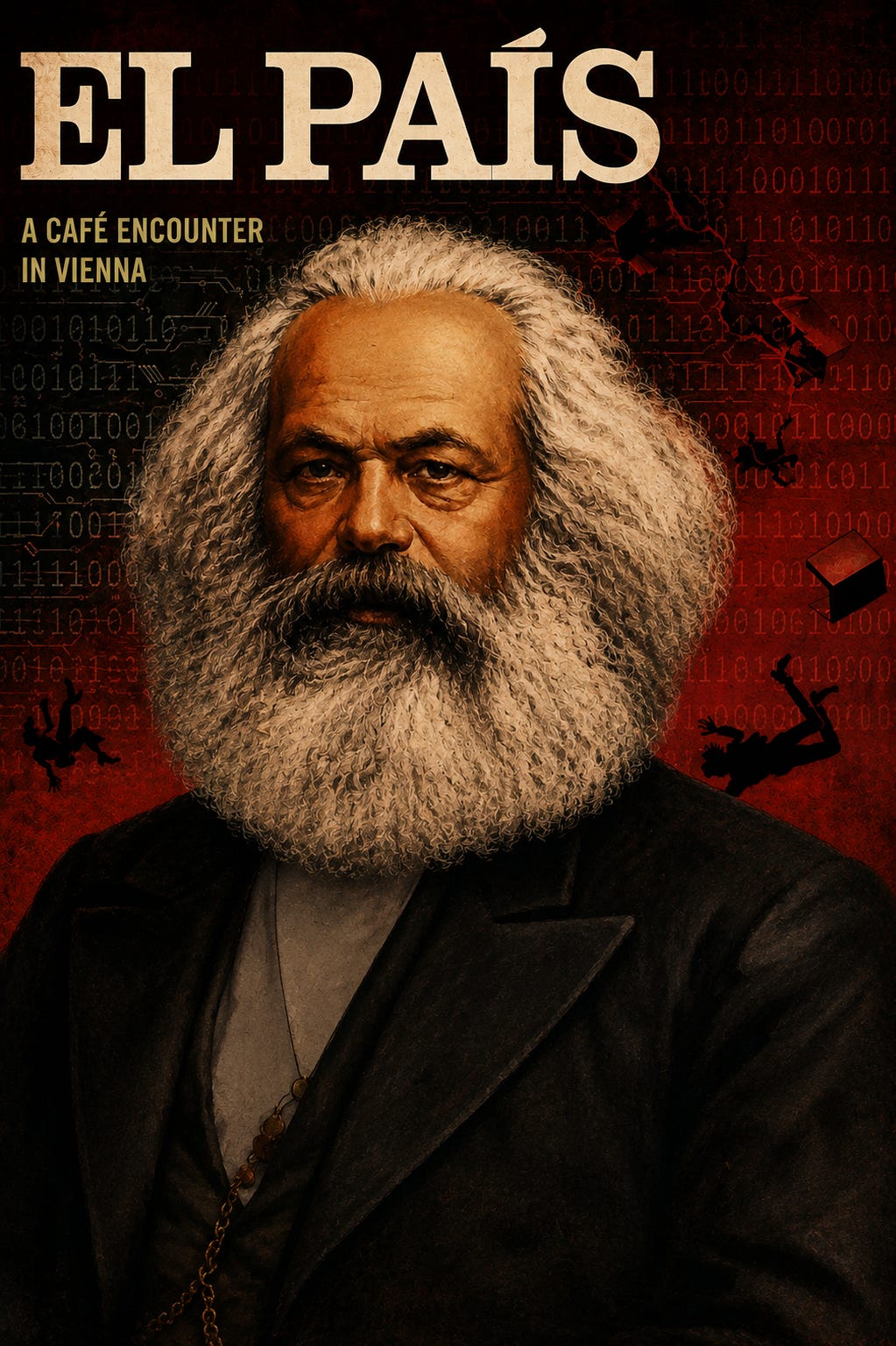
He apologised before he spoke, which is how these things begin, I guess. I was on the terrace at Café Hummel on a warm evening when the man at the next table leaned over. He’d heard me speaking French on the phone and wanted to know where I was from.
The day before, that week’s Der Spiegel had been hanging from the Zeitungshalter beside me with Marx on the cover. Now the man at the next table had almost exactly the same head: the heavy white beard spilling off the jaw, the wild corona of hair, the dark coat. Marx down to the hairline. His voice, though, was Kissinger: gravelly, patient, educated, unhurried, mitteleuropäisch. He said he had been an economist.
He said he lived in Währing, the eighteenth, which I’d read was a posh old academic sort of neighbourhood. Yet here he was, in this local, on this terrace.
He said he had a daughter living here in Josefstadt, the eighth, studying linguistics. She wasn’t at the table.
Did she even exist? I couldn’t stop myself from wondering. He was clearly a regular at a café in his daughter’s neighbourhood, without his daughter. All perfectly possible: he had just visited her, or visited so often he’d become a regular, or she was in a hospital nearby dying of cancer, or she didn’t exist at all.
The fact that this real or imagined daughter studied linguistics gave him his hook line. He talked about the place I come from, the Spanish-speaking world, and language. He admired the newspapers the café keeps on their long wooden rods, the NY Times, Le Monde, and wondered why El País was no longer among them. Perhaps something had changed with the editors, he thought, or there simply weren’t enough Spanish readers anymore. He seemed genuinely bothered by its disappearance. He could read Spanish, he told me, but neither speak nor follow it spoken — demasiado rápido, he said more than once.
Then he recited something. The people of Sevilla, the Andalusian tongue, carried across the ocean by the conquistadors and becoming, over centuries, the Spanish of the Americas. He delivered it as established fact, and I received it as one. I never afterward bothered to confirm whether it was true. By then it didn’t matter.
That was the hour, more or less. A man reciting things I would not verify, about a country whose language he could not speak, a profession he would not discuss. He did not mention Austria. He spoke of French but never of Paris. Everything he offered was a fact about somewhere else, and every fact was the kind one cannot check by looking at the man in front of you.
The café ended it before we did. They turned off the lights along the terrace around 11 pm: closing time, stated in the only language cafés use for it. We rose with something like regret, and he went off toward the eighteenth, or toward wherever it was he went. I never learned his name.
I have since decided, for my own convenience, that it was Gerhardt. I have exactly as much evidence for that as for everything else he told me, which is to say none.
Any cafe. Any body. Table for one, but conversation over head. Assumptions, interjections, characters imagined. Time passes.lights blackout. What a staged play. Assume bar bill paid.
I’ve had dates like that. One liners, shoot the breeze. Sometimes wake up next to someone and wonder what happened?
When a third party ends the conversation, it only means it was overly interesting. Funny how it leaves behind nothing but assumptions and not a single answered question x