

Homebound
How To Be Small

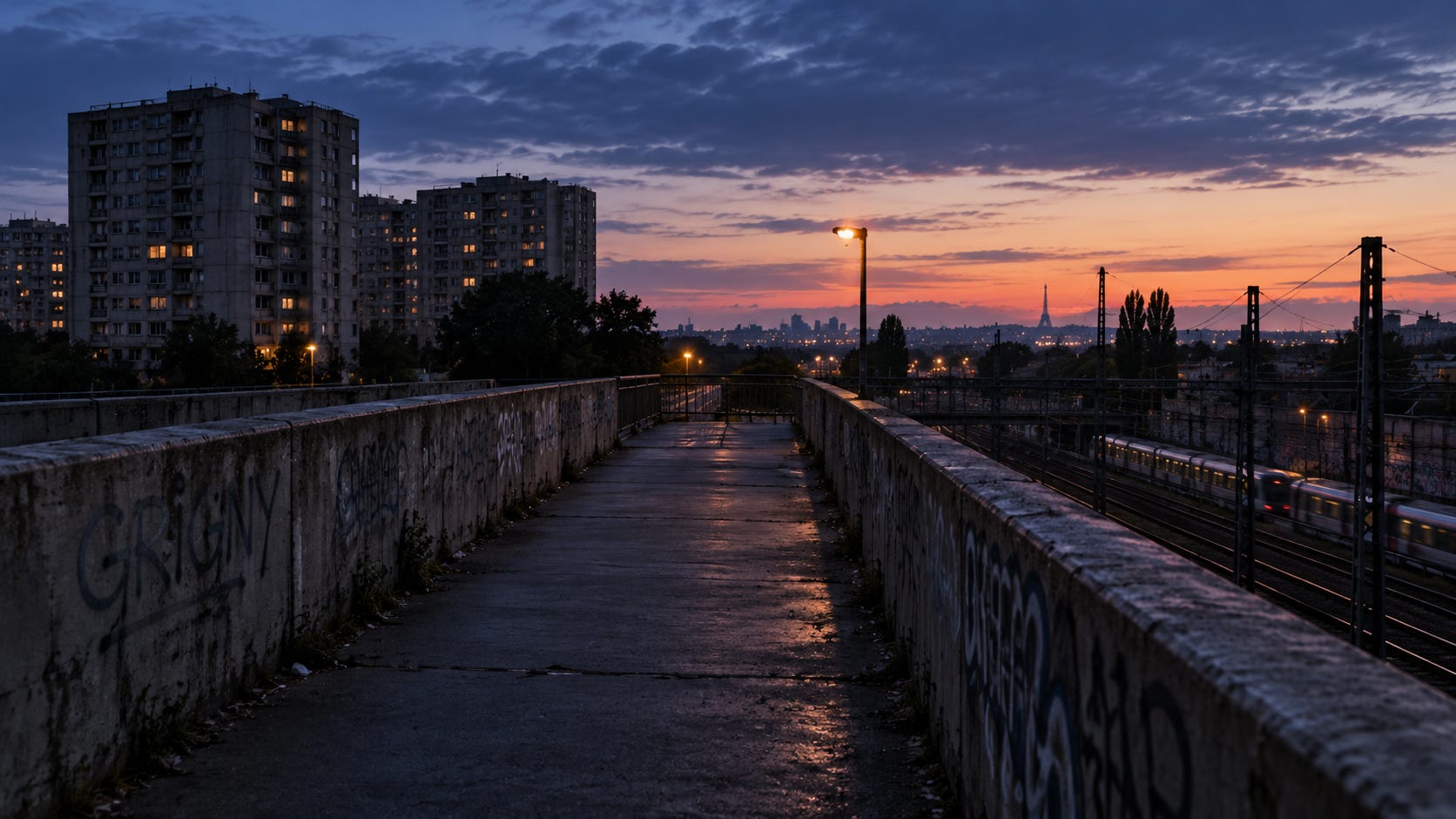
A child assumes his world is the world.
Cracked concrete, leaking balconies. A one- bedroom flat in a tower in Grigny. Maman sleeps on the sofa. He and his brother sleep in a bunk bed in the lone bedroom.
He plays football in concrete courtyards. Dreams of being Makélélé.
At twelve, another kid says: “Come on, we’re going to Paname.”
“How?”
“We jump.”
He watches an older boy vault the turnstile at Grigny-Centre. His own heart is pounding. Not because of the law, but because this is the first independent expedition of his life.
The train itself is part of the story. The RER isn’t transport. It’s a corridor between universes.
For thirty-five minutes they’re loud, laughing, shoving each other.
**
Bofosa has been to Les Halles six or seven times. He’s loud with his mates. They eat McDonald’s, try on trainers, watch girls. This is freedom. But then it is not.
The police stop them:
“Carte d’identité.”
The smile dies on Bofosa’s face before he even fully realises it’s leaving, sliding right off like grease down a cold plate.
He thinks it’s for turnstile hopping. It’s not.
He has no identity card. Nobody warned him.
“How old are you?” Eyes narrow, searching.
“Twelve.”
They wave him on. Too young. Next time.
One of the other kids pulls him away when he wants to know why.
« Calcule pas, t'inquiète c'est l'habitude. Reste carré. »
Don’t sweat it, get used to it. Stay clean.
He doesn’t even know what it is but he shuts up.
**
“Maman, what is a carte d’identité?”
He asks her a few nights later, while she is sitting at the small kitchen table, dabbing her tired feet with a damp cloth under the dim yellow light of the overhead bulb.
Her eyes narrow instantly.
“Why do you want to know that?”
He shrugs, keeping his hands stuffed in the pockets of his tracksuit bottoms, trying to look as casual as possible against the doorframe.
“Un poto was talking about needing one.”
“You don’t need it. You are twelve. You stay where you belong, you don’t need papers to walk in the street.”
Now he associates Paris with trouble, not freedom. He invents excuses not to go back.
**
He does go back. He’s fifteen now. In Grigny, you are invisible, stuck behind concrete walls and broken lifts. In Châtelet, you are surrounded by millions of people, yet you feel intensely watched by the cameras, by the guards, by the tourists who pull their bags a little closer when a group of teenagers walks past.
He never got the ID card. Too many documents, maman is too busy. He goes back to Paris a few times no problems, but then he gets stopped again. He isn’t caught by surprise. He shrugs. Non. Pas de carte d’identité.
“Pas de carte?”
“Non,” Bofosa says.
His voice doesn’t shake. He practiced the shrug in his head a dozen times since the last time, keeping his hands loose in his pockets so they can’t see his fingers twitching. He knows the drill.
The cop sighs, a short, heavy puff of air that smells faintly of garlic, and gestures with a jerk of his chin toward the back of the station exit where the modular security post sits, tucked near the RER platforms.
“Avance. On y va.”
They don’t let him walk with his mates. One officer steps close, his hand resting casually, not violently, but heavily, on Bofosa’s elbow, steering him away from the group.
His friends don’t try to intervene. They watch with a mixture of anger and absolute resignation. One of them calls out something low, “Laisse-le, il a rien fait,” and a second cop just turns, resting a hand on his belt, and gives them a flat, dead-eyed stare that tells them to keep walking or join him. The group backs off, dissolving into the passing crowd of shoppers and commuters.
Bofosa has already learned not to care. Nothing wrong. He sits on that bolted-down plastic chair for two hours, the officers are running his details through their terminal.
Finally, they hand him a procès-verbal de vérification d’identité.
**
The following Saturday, maman is at the kitchen table, waking up to coffee. Staring at nothing. Eyes open. He reaches into his bag, pulls out the crumpled white slip, the procès-verbal de vérification d’identité, and drops it flat on the linoleum table next to her coffee mug.
***
When maman helped him process his carte d’identité, he saw it. On the birth certificate. Père: Jean-Pierre Likunde.
Nothing. He carried on.
Now he spends more time in Paris. It’s another world. He goes beyond Châtelet, beyond Les Halles. The world is opening up to him. That world costs money.
A backpack full of untaxed cartons or unmarked packages dropped off at a specific cafe near Porte de la Chapelle. He takes the RER D up, hands over the bag, takes the envelope of cash minus his cut, and comes back down before dark.
It is cash in hand, folded small into the coin pocket of his jeans. It pays for phone credit, tobacco, and whatever he leaves on the kitchen table so his mother doesn't have to ask where this month's electricity money came from.
Time has no real shape. One week is no different than the next. Nothing to fear, nothing to look forward to. Waiting to get a text back from a girl. Waiting for a bus. The months are different because the seasons change. It gets hotter or colder. People come and go.
Somebody vanished behind the heavy doors of Fleury-Mérogis or Fresnes for six months over a stash bag or a stolen scooter.
He was 9 when France won the World Cup. He remembers the fireworks and shouting. He followed football but not enough to care. He didn’t feel French any more than he felt Congolese. His father was out there somewhere.
This summer he watched Congo play in the World Cup. They all stood around a cracked 40-inch plasma propped on a milk crate outside the épicerie at the foot of the tower. The neighbourhood was tense and excited. Eighteen million countrymen he didn’t know. Every match was electric. He felt something for once. Time had meaning. Waiting for Yoane Wissa to score.
When Congo presses down the left wing, the whole row leans forward as one body, heels coming off the pavement.
“Wissa—vas y, putain—Wissa!”
That was weeks ago. He misses that sensation of belonging to a hope. Time had meaning at that moment but now, time is back to zero.
It was a surge of energy he’d never felt. Non. Once, when he was first with Lili.
He got a taste and he wants more. He wants to go to Kinshasa. He lies to his circle, brags and says his father is going to buy him a ticket to visit. The boys are jealous. They’ll forget it and not ask in six months what happened when he never goes.
But he knows.
The word “père” is abstract to him. Like billet. Like Kinshasa.
He looks up travel agencies and finds the cheapest ticket is around 700 €. That’s the cheapest. Some are double that price.
A week or two later he asks maman one evening late, when she gets home. Has she ever thought about going back to Kinshasa?
A little laugh escapes her that she is grateful for. She looks at her son carefully.
“Go back? For what? To find your father?”
He shrugs then shakes his head reluctantly.
“I’m sick of having no hope.”
Her eyes open wider despite her fatigue. She’d never heard him complain.
“I didn’t leave just so I could run back later. This is where I am. This is where we are, my son. Home.”
“It doesn’t feel like home, Maman.”
“Mwana, your father stayed here long enough to produce two boys he would never see again. He hated it here. He said he felt like a half man.”
She leans in closer, nearly a whisper of fatigue. “He wasn’t a half man. He was just a man who couldn’t figure out how to be small.”
The most painful distance here is not between Grigny and Paris, or France and Kinshasa, but between a person and the place where they are told they belong. Bofosa is searching less for another country than for a life in which hope can finally take shape. That final line is devastating because it reveals how survival sometimes demands a kind of smallness that can preserve a life, yet quietly diminish the person living it.
What an ending. This is a heartbreaking piece, Jaap, and so many layers - displacement, identity, hope, the father's absence, and then the harsh reality of the banlieusards... The mother is so brave and so tragic.