
Existence Has Momentum
Unexpectedly Marooned in Sciacca, Day One

The transistor in the bathroom comes on like an alarm. I stare up at the ceiling high, vaulted, heavy damp stone, the belly of a convent or a merchant’s cellar turned guesthouse. The mattress is sand and salt air and something that never fully dried. The taste of chemical copper still coats the back of my throat.
The journey is a series of blurred, overexposed slides. The Corriera from Palermo, a handful of crumpled euros into the driver’s palm while the edges of the world softened. Or a ceramicist hauling kiln-fired heads, the Sicilian interior bleeding from green to dusty yellow against the vibrating window.
The room smells of floor wax. The windows are open. Light breeze from the north-west, which means no Tunisian smells. No air choked with harissa or the scent of Tunisian jasmine, the smell of tiny, tight white buds hand-bound into small bouquets sold on street corners. No honeyed floral or sharp, pungent heat of red peppers being pounded with garlic, caraway, and cumin. I am disappointed. I expected to be in Tunisia by now.
The radio: Maria… Lucio… la mamma di… un abbraccio, grazie… tre cinque uno novanta due venti…
I guess this is the telephone number. Shall I call in and say: mama mama Lucia, mia mama mama Lucia, and then hang up? But why? Because I need attention. It’s not the radio static. It’s in my head.
…pronto, pronto. Anna. Francesca. Filomena. Costanza ha mamma Angela. Una bambina chiamata al telefono dalla mamma – saluta, augura auguri – ciao ciao grazie ciao.
I hold a phone in my hand and think: Lucia. Mia mama. And then I put it down. It must be Mothering Sunday here.
On the table beside the bed, a note.
Camera 4 — Pernottamento. Soggiorno €65. Caffè e brioche: offerto, o incluso nel disturbo. Tassa di soggiorno €2. Totale: €67.
Below the total, blue ink, slightly smudged:
Il bus per Palermo parte dalla piazza alle 14:00. Non ci sono barche per la Tunisia da Sciacca. Inutile guardare il mare, il mare non risponde.
And below that, in dialect, leaning into itself like the houses in the Terravecchia:
Forza, ca u mari d’unni ccà nun porta a nudda banna.
The sea from here leads nowhere.
I get up anyway.
**
Palermo Catania direzione prossimità occidentale duecento metri Marsala una provincia —
I realise the radio has already forgotten Filomena, already forgotten Francesca and her mother, already moved on to the next thing because that's what the radio does, that's what everything does.
duecento metri, una provincia, the sea from here leads nowhere, I get up anyway.
**
The radio cut through the fog of whatever I swallowed between London and Palermo. It wasn’t just drink. No, alcohol has a messy, heavy gravity. This is different. More of a jagged, hallucinatory clarity, the kind that comes from shrooms or a bad batch of something synthetic taken in a Heathrow toilet.
It comes back piece by piece, as though the voice directing the traffic of my thoughts only feeds me small, easily digestible pieces. Too much at once, I might choke. The grit of the Bristol platform, the shouting…my voice or hers, I can’t distinguish anymore, or don’t want to, I know inside that I have nothing to gain from knowing.
Maybe that vertical drop of the flight. “We are now descending,” the pilot intones over the speakers. We know. I was a man possessed by a singular, administrative goal: Tunisia. It was that story about the Romans sowing the soil with salt, ensuring that nothing, not even a memory, could ever take root again. I wanted that sterility. Cleansed of regrets.
But I’m not in Palermo or Tunisia, I’m in Sciacca, trapped in the humid weight of overripe lemons and the endless, fertile loop of the local radio.
**
“Musica italiana… Italia love-a…” the man intones. “Le più belle canzoni italiane. Love… le canzoni più belle italiane…”
So this is 80s music in Italy. The Dire Straits-like guitar, the Vasco Rossi, the sound itself, the percussion, as if everyone used the same drum machine back then…
Did they not make it to the 21st century?
**
The woman in the lobby is folding napkins with a precision that frightens my internal chaos. I settle the bill of course, get on their good side. I take the coffee. It’s viscous, a black oil that tastes like scorched memories. I have done that. Impulsive. Fucked again. This is not the first time. The crutch of the radio is gone.
“The sea from here doesn’t lead anywhere,” the note had warned in that sharp Siciliano script. It’s right. From this port, the Mediterranean is just a sequence of shifting blue plates. It looks like a gateway, but the logistics are a wall. I’ve sown my own path with salt, it seems, and now I’m stuck.
I need to move, but not far. I need to descend further into the mundane to stop the vibration in my head. I’ve worked out a cheap agenda. Find a place I can stay a few days or a few weeks for cheaper. Is there tourist shop? I want to send a postcard to Maya and tell her where I am in case she cares...
I don't want to make her jealous with the sun and sea while she rides in sunken lanes and centuries of rain. I want her to think about what she could be doing. If I send the postcard I can slip in there, into her thoughts...She wouldn't just bin the postcard without looking so that's the first goal: one postcard, postage stamp to her, up there in Devon...
****
The sun turns the white limestone of the piazza into a glare that forces me to squint. The yellow liquid in my glass is a Seltz, Limone e Sale, the local cure for the heat. Vibrant, stinging, and topped with a layer of fine salt that clings to the rim. It’s a sharp contrast to the spectral flavour of raw iron in my mouth.
The town is in a state of suspended animation. Across the square, two old men are leaning against a low wall, their skin the texture of cured leather, watching the port with a patience that only comes from knowing the fish don’t care how long you wait. The nets are piled in the shade, smelling of brine and slow decay.
**
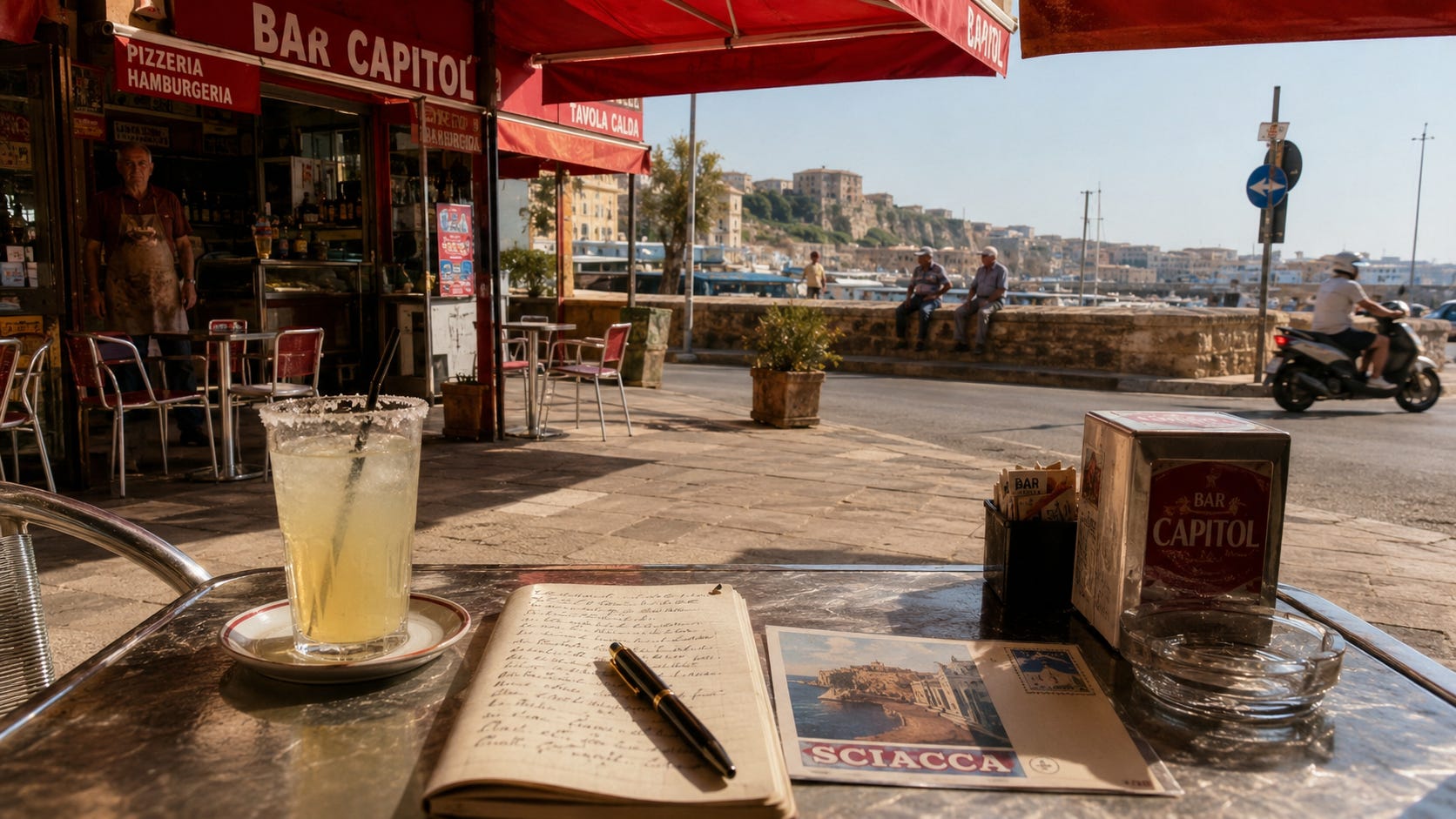
The Bar Capitol is not a place for seekers. It’s a roadside stage of red plastic and sun-bleached awnings, a functional slab of concrete without any convincing shade. I sit here, anchored to a metal chair that’s been baked by the Sicilian sun until it threatens to sear through my tan trousers, listening to the hum of the refrigerators and the occasional hiss of a steaming espresso wand.
The facade is a cluttered mess of commercial promises: Pizzeria, Hamburgeria, Tavola Calda. It’s a temple of the immediate, the kind of place that exists to feed the hunger of people who are actually going somewhere. The red canopies overhead don’t cool the air; they just trap the scent of old frying oil and exhaust from the scooters that buzz past like angry hornets.
The light bounces off the pale pavement with a violence that makes the “Bar Capitol” sign look like a neon bruise against the sky. Everything is too bright, too exposed. It’s not the right place to write. I will write anyway because I’m here. I’ve got my postcard and my stamp.
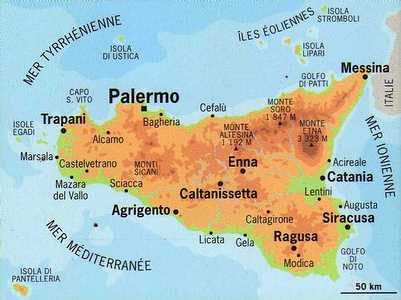
It isn’t a photograph of a sunset or a Baroque cathedral; it’s a clinical, topographical map of the island. If you squint, you can see Sciacca.
“Dear Maya, I’m here. A man in a stained apron stands in the shadows of the doorway, watching the street with a blank, heavy-lidded indifference. To him, I am just a white shirt and a bill to be settled.”
I feel the grit of the limestone dust and the dried salt from the harbour. Everything smells of salt or fish or crispness until the burning sun covers it all in the subtle smell of suffocation.
I look at the postcard. In Devon, there are tea rooms with lace curtains and damp gardens. Here, there is only the red awning, the smell of diesel. Maybe I could hire a boat and go somewhere. Where, though? Tunisia straight ahead but I can’t go out there that far. I pick up the pen again. The contrast is the point. I want her to imagine me here, in this temple of the mundane, drinking salt while the land runs out.
I leave the card on the table for a moment to let the ink dry in the Sicilian heat. I stand up, the salt from the glass still on my lips, and walk toward the Tabaccheria. I must find a new place, less depressing. The shift is sudden: they seem to be reading horoscopes now on the radio inside “Bar Capitol”.
L’amore è il protagonista.
This scrap will let her know that I am still here, at the end of the land, waiting for the next thought to arrive.
I don't know anyone else on here who writes place like you do, Jaap. The places are like whole characters of their own in each of your stories. And I love the way you build a place out of so many particular and unexpected sensory details.
This whole piece feels like a broken, unstable radio transmission, the creaks and crackles of searching amidst years of piled-on scraps. It is large in its insistence on maintaining momentum.